
Hockey Stick Weights for Training: Complete Guide
Table of Contents
- What Are Hockey Stick Weights and How Do They Work
- Benefits of Weighted Stick Training for Shot Power
- Weighted Hockey Stick Benefits Beyond Shot Velocity
- Hockey Stickhandling Drills With Added Resistance
- Choosing the Right Weight and Size for Your Needs
- How to Use Hockey Stick Weights: Step-by-Step Training
- Safety Considerations and Injury Prevention
- Lamplighter Hockey Stick Weight Options and Pricing
- Frequently Asked Questions
Last Updated: October 7, 2026
What Are Hockey Stick Weights and How Do They Work
Hockey stick weights for training are weighted inserts that fit inside your stick shaft, adding resistance during off-ice practice. Remove the top plug, slide the weight in, and train. At game time, remove it for an immediate boost from the contrast effect.
The science centers on progressive overload and neuromuscular adaptation: your muscles and nervous system adapt to the resistance, making your unweighted stick feel lighter and faster. Baseball players swing weighted bats and sprinters wear weighted vests for the same reason.
Lamplighter Hockey offers three sizes: 1/2-pound for youth (8U and Mites), 1-pound for all ages, and 2-pound for stronger players 13 and up.
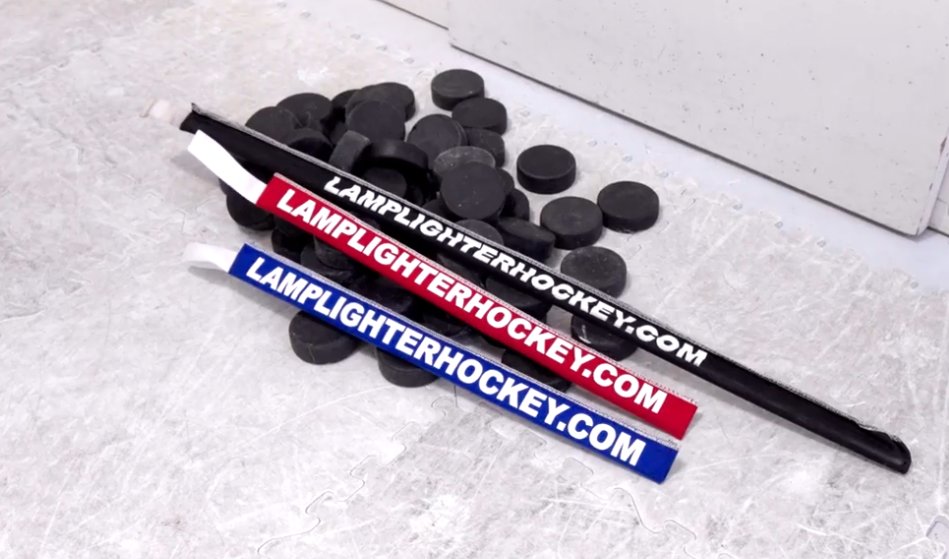
Lamplighter Hockey Stick Weight (available in 3 sizes)
What makes hockey stick weights for training different from a heavier stick is control. A heavier stick changes blade feel and balance throughout. A shaft-inserted weight maintains blade responsiveness while adding resistance where it matters most for shot development and stickhandling.
Benefits of Weighted Stick Training for Shot Power
Adding resistance during training directly increases shot velocity. Your muscles work harder to accelerate the stick through the shooting motion, building the wrist and forearm strength needed for more powerful shots. Remove the weight during games and your stick feels effortless by comparison.
The mechanism is the contrast effect, or post-activation potentiation: your neuromuscular system adapts to the heavier load, then explosively overcompensates when it's removed. Players notice immediately, shots feel faster, the puck leaves the blade with more zip, and accuracy often improves.
One player using Lamplighter Hockey stick weights won the hardest shot competition at 81 km per hour, 10 km per hour harder than the next closest competitor. Another parent noted their 15-year-old son's shot improved significantly after beginning training with the weights.
Shot power improvement doesn't require perfect technique coaching. Proper mechanics matter, but resistance training creates measurable velocity gains regardless of current form. Combining weighted stick training with technical coaching produces the fastest improvements.
Weighted Hockey Stick Benefits Beyond Shot Velocity
Building Upper Body Strength and Wrist Power
Wrist strength is foundational for hockey performance. The repetitive flexion and extension of stickhandling and shooting builds the forearm muscles that control accuracy and power. With hockey stick weights for training, those muscles work harder every rep.
Upper body conditioning extends beyond your wrists. Your shoulders, upper back, and core all engage during shooting and stickhandling, and the added weight demands more activation. Players often maintain shot power later in games and throughout seasons, since fatigue doesn't degrade performance as quickly.
This strength also improves puck protection in traffic. Stronger wrists and forearms give you better control under checking and let you hold stick positioning in tight spaces longer.
Developing Muscle Memory for Game Performance
Muscle memory is the nervous system's ability to execute a movement automatically after repeated practice. Performing the same motion hundreds of times with added resistance encodes that pattern more deeply, so your body "remembers" it even when conditions change.
The transition back to unweighted play is where muscle memory creates the edge. Your nervous system has trained at a higher resistance, so normal stick weight feels lighter and easier to control. Mechanics stay the same, but execution becomes faster and more explosive.
Consistency matters. Players who train with hockey stick weights for training every practice, not sporadically, develop stronger muscle memory, since repetition volume drives neuromuscular adaptation. Fifty weighted shots per practice beats 10 per week.
Hockey Stickhandling Drills With Added Resistance
Stickhandling with added weight builds hand speed and puck control at once. Start with figure-eights, cone weaves, and tight toe drags: 30 seconds at game speed with the weight, then remove it and repeat for 30 seconds.
Progress to game-realistic scenarios: receiving passes under pressure, transitioning to quick shots, and protecting the puck along the boards against an imaginary defender. The added resistance forces better technique, since sloppy hand positioning is harder to hide.
One effective progression is the "heavy-to-light" sequence: 45 seconds of a drill with the weight, then immediately remove it and continue the same drill for 45 seconds at game speed. The contrast effect applies to hand speed as it does to shot velocity, and over weeks your baseline hand speed increases.
Incorporate these drills into every practice. Of 15 minutes of stickhandling work, dedicate 5-7 minutes to weighted drills and 5-7 to unweighted game-speed work, developing strength and speed without overloading your nervous system.
Choosing the Right Weight and Size for Your Needs
Weight Increments by Age and Skill Level
The 1/2-pound weight is designed for youth players 8U through Mites, who are still developing basic stickhandling and shooting skills. A lighter weight adds resistance without compromising technique, while too much weight creates compensatory movements that ingrain poor habits.
The 1-pound weight works for all ages and skill levels. It's heavy enough to create meaningful resistance for adults and competitive youth players, yet light enough that younger players avoid form breakdown. Most players start and stay here unless training for elite-level power development.
The 2-pound weight is reserved for stronger players 13 and up who are comfortable with weighted training. Technique must be solid, since sloppy form becomes immediately obvious and uncomfortable. Use it only after adapting to the 1-pound weight for at least 4-6 weeks.
The key principle is progressive overload: start lighter, master the movement pattern, then increase resistance. Jumping straight to the 2-pound weight often leads to form breakdown and injury risk.
Progressive Overload: Building Training Intensity
Progressive overload in hockey stick weights for training means systematically increasing the challenge to your muscles and nervous system by manipulating weight, training duration, repetition volume, and intensity (speed of movement).
Start with 5 minutes of continuous stickhandling and shooting drills with your chosen weight. Extend to 7 minutes in week two and 15 minutes by week four. Your body adapts to each progression, keeping the stimulus challenging.
Alternatively, increase intensity by speed: week one at 75% game speed, week two at 85%, week three at game speed. This develops explosive power while building strength.
Repetition volume is another variable: 20 weighted shots per session, then 25 the next week, then 30. The cumulative load rises gradually, which is safer and more sustainable than jumping from 20 to 40 shots overnight.
The principle applies whether you train shot velocity, stickhandling, or general upper body conditioning. Change one variable at a time, hold it for 2-4 weeks, then progress, producing consistent improvements without plateaus or injury.
Lamplighter Hockey Stick Weight (available in 3 sizes) →
How to Use Hockey Stick Weights: Step-by-Step Training
Inserting and Removing Weights From Your Stick
The process requires no special tools. Locate the plug at the top of your stick, a small cap sitting flush with the opening, and gently remove it by hand or with a slight twist. Set it aside where you won't lose it.
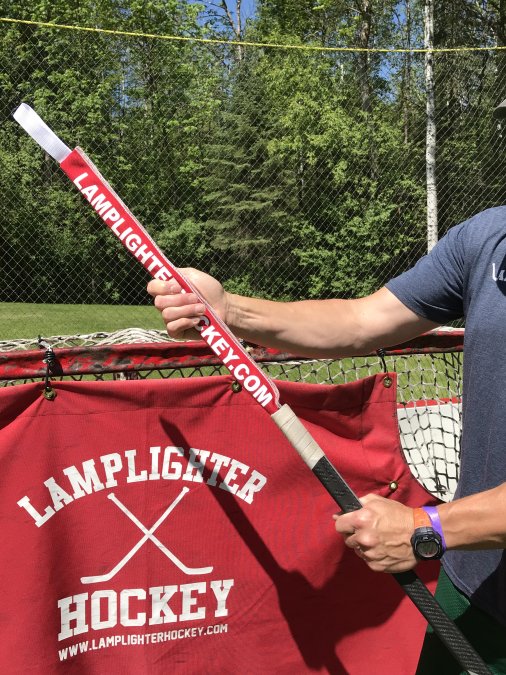
Picture showing how to insert a training weight into the hollow shaft of a hockey stick
Hold your stick vertically, blade down, align the weight with the shaft opening, and slide it in. It should fit snugly at the bottom of the shaft. Replace the plug, twisting gently until seated, and you're ready to train.
Removing it is just as easy: pull the plug, hold the stick vertically, and slide the weight out. A gentle tap on the shaft dislodges it if it sticks, then replace the plug.
The Lamplighter Hockey design makes this take under 30 seconds, with no tape, stick modification, or damage risk. The weight fits securely without marring the shaft interior, and players report the process becomes automatic after a few insertions.
Effective Training Frequency and Duration
Training with hockey stick weights for training works best integrated into your regular practice routine. Use the weight every session, not occasionally, because consistency drives adaptation.
A typical session: warm up unweighted for 5-10 minutes, do 10-15 minutes of weighted stickhandling and shooting drills, then finish with 5-10 minutes of unweighted game-speed work. The contrast between weighted and unweighted work triggers the performance boost.
Keep total weighted training under 20 minutes per session, especially early on. Your nervous system needs recovery, and overtraining with added resistance leads to fatigue and decreased performance rather than improvement.
Frequency matters more than duration: 15 minutes five days per week beats 60 minutes once per week. Muscles and nervous system adapt through consistent stimulus, not occasional heavy sessions.
Plan training in 4-week blocks: weeks 1-2 establish baseline adaptation, weeks 3-4 slightly increase intensity or volume, then a deload week of just 5 minutes per session allows full recovery. This cycle prevents overuse injuries and keeps your body responsive.
Safety Considerations and Injury Prevention
Weighted training carries risks if approached carelessly. The most common mistake is progressing too quickly or using too much weight before adapting.
Watch your wrist and elbow, which bear significant load during shooting and stickhandling. Sharp joint pain, as opposed to muscle fatigue, means stop immediately and remove the weight.
Proper technique becomes even more critical with added weight. If your form breaks down, dropping your elbow, rotating your shoulders incorrectly, or compensating with your back, the weight amplifies those flaws and raises injury risk.
Adding resistance to shooting increases shoulder stress, since your rotator cuff must stabilize the joint through a greater range of motion.
Youth players need extra caution, since growing bodies are more vulnerable to overuse injuries around the wrist and elbow growth plates.
Lamplighter Hockey offers free replacement for torn or ripped fabric on their stick weights, reflecting confidence in durability. The weight itself is virtually indestructible and won't break or degrade with normal use.
Training Variable |
Beginner |
Intermediate |
Advanced |
|---|---|---|---|
Weight Size |
1/2 pound or 1 pound |
1 pound |
1 or 2 pounds |
Session Duration |
5-10 minutes |
10-15 minutes |
15-20 minutes |
Frequency |
3-4 days per week |
4-5 days per week |
5-6 days per week |
Intensity |
70-80% game speed |
85-95% game speed |
Game speed + explosive |
Recovery |
Full week deload every 4 weeks |
Deload week every 4 weeks |
Deload week every 3-4 weeks |
Lamplighter Hockey Stick Weight Options and Pricing
Lamplighter Hockey offers three primary products for shot power development. The Lamplighter Hockey Stick Weight comes in three sizes and starts at $45.00 for a single weight.
For teams and associations, the Team Order of Lamplighter Hockey Stick Weights provides bulk purchasing at $479.88 for a team package.
The Power Package combining Lamplighter Hockey Stick Weight and PowerSk8r Skate Weight is priced at $84.99 and pairs stick weights with skate weights for comprehensive lower and upper body development.
The company was founded by a hockey family with deep roots in the sport. The founder holds a degree in Physical Education from the University of Regina, Canada.
Players using Lamplighter Hockey stick weights report significant improvements.
Lamplighter Hockey also offers travel clinics to local communities and associations, teaching proper weighted training technique, progressive overload protocols, and sport-specific strength development.
Lamplighter Hockey stick weights are virtually indestructible, with high-quality materials that withstand daily use on and off the ice.
Shot power development isn't complicated, but it requires commitment.
Frequently Asked Questions
Do hockey stick weights actually increase shot speed?
Yes. Hockey stick weights add resistance during training, which builds the wrist strength, forearm development, and explosive power needed for faster shots. When you remove the weight during games, your stick feels lighter and your muscles fire with greater velocity. Players report noticeable improvements in shot speed after consistent training with weighted sticks over several weeks of progressive overload.
How much weight should I add to my hockey stick for training?
Start with 1/2 pound for younger players (8U and Mites) or those new to weighted training. Most players across all ages benefit from the 1-pound stick weight, which balances resistance without compromising technique. Stronger players aged 13 and up can progress to 2 pounds. Begin with a lighter weight, master proper form, then increase resistance as your strength and muscle memory adapt.
Will using a weighted stick mess up my actual game or shooting technique?
No. The Lamplighter Hockey Stick Weight is engineered with optimized weight distribution that maintains your natural movement and blade feel during training. The weight slides inside your stick shaft without affecting balance. Importantly, you remove the weight before games—it's strictly an off-ice or practice training tool. This approach builds strength during training while preserving your game mechanics when it counts.
How often should I use a stick weight during practice?
Use weighted stick training during every on-ice practice and off-ice drills, then remove the weight for games. Consistent, frequent use drives neuromuscular adaptation and muscle memory development. The key is repetition volume and progressive overload—the more often you train with resistance, the faster your shot power builds.